
Best Commercial Patio Furniture Materials
A patio can look finished on opening day and still become an operational problem by the end of its first season. Sun exposure, stacked chairs, poolside moisture, food service traffic, and frequent cleaning all place demands on furniture that residential products are not built to handle. The best commercial patio furniture materials are the ones that match the site conditions, service model, maintenance capacity, and expected useful life of the project.
For restaurant operators, hotel teams, property managers, and design professionals, material selection should start with performance rather than color alone. A material that works well on a covered rooftop in a dry climate may be a poor fit for an uncovered coastal dining area. The right specification protects the guest experience while reducing replacement cycles, labor, and disruption to daily operations.
How to Choose the Best Commercial Patio Furniture Materials
Start by separating the project into its working components: frame, seating surface, tabletop, cushions, and hardware. Outdoor furniture rarely succeeds or fails because of one material in isolation. A well-built aluminum frame can still create a maintenance burden if its cushion fabric retains moisture, while a durable table base may not be suitable if its top stains easily from food and beverage service.
Exposure is the first consideration. Direct sun can fade finishes and weaken lower-grade plastics. Rain and humidity can affect wood, steel, fabric, and fasteners. Salt air accelerates corrosion, while freeze-thaw conditions challenge porous materials and finishes. Covered spaces have more flexibility, but commercial traffic still calls for materials that can be cleaned, moved, and used repeatedly without loosening or looking worn.
Also consider how the furniture will be handled. Stackable dining chairs need reinforced contact points and finishes that resist abrasion. Poolside loungers require noncorrosive frames and quick-drying surfaces. Restaurant tables need stable bases and tops that tolerate spills, sanitizers, hot plates, and frequent wiping. These practical details should guide the specification before aesthetic preferences narrow the options.
Aluminum: The Most Versatile Commercial Frame Material
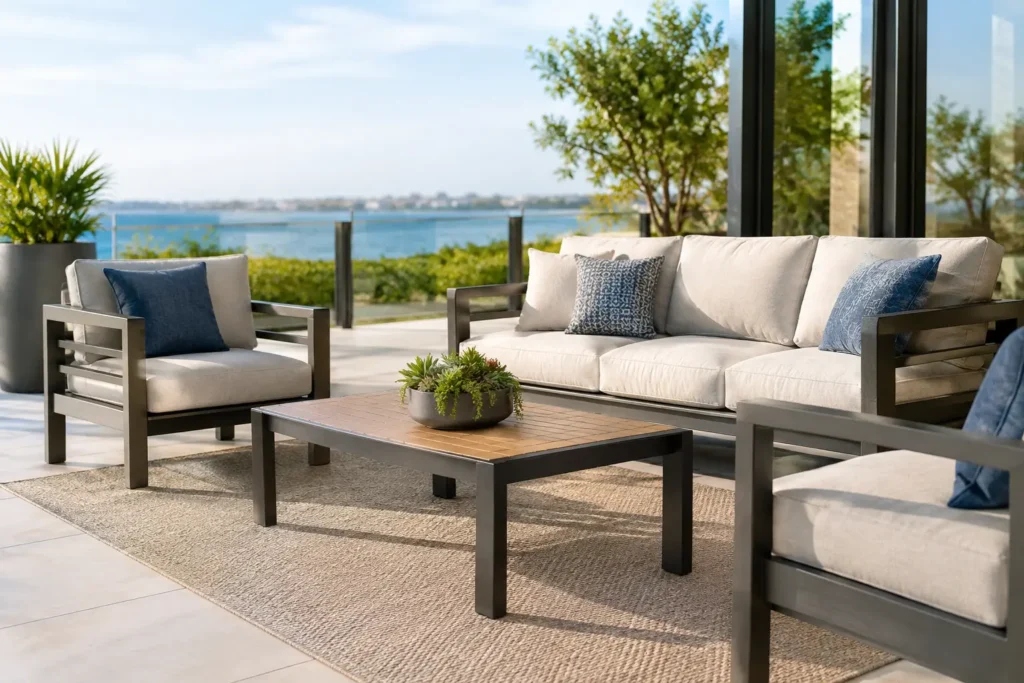
Powder-coated aluminum is often the strongest all-around choice for commercial patios. It is lightweight enough for staff to reposition, naturally resistant to rust, and available in a broad range of profiles and finishes. It works especially well for restaurant dining, hotel terraces, rooftop lounges, multifamily amenity areas, and pool decks.
Not all aluminum furniture performs at the same level. Commercial-grade frames should use substantial wall thickness, welded construction where appropriate, quality powder coating, and protected hardware. Thin tubing, weak welds, and low-grade finishes may reduce upfront cost but can lead to bending, chipped coatings, or instability under commercial use.
Aluminum also supports a coordinated design scheme. Chairs, lounge seating, tables, and occasional pieces can be specified in aligned finishes, while custom cushions or sling colors carry the property brand through the space. For many projects, its balance of durability, manageable weight, and design flexibility makes aluminum the practical baseline for comparison.
Steel: Strong, Stable, and More Demanding Outdoors
Steel provides a substantial feel and is often selected for industrial, contemporary, or hospitality-driven designs. It can be an effective option for fixed-feeling dining settings, heavier table bases, and sheltered patios where wind resistance matters. Steel furniture generally offers excellent strength and can support clean, slim silhouettes.
Its limitation is corrosion risk. Powder-coated steel must be maintained carefully, especially at welds, joints, and any areas where the finish becomes chipped. In humid, rainy, or coastal locations, exposed steel can rust quickly if coating quality and touch-up practices are not adequate. Stainless steel offers better corrosion resistance, but grade selection matters, and it typically carries a higher project cost.
Steel is best used when its weight and visual character serve the space, not simply because it appears durable. For exposed dining patios with limited maintenance resources, aluminum may deliver a more reliable long-term result.
Teak and Other Woods: Warmth With a Maintenance Commitment
Wood brings a level of warmth that metal and resin materials cannot fully replicate. Teak is the most recognized commercial outdoor wood because of its natural oils, density, and ability to withstand moisture better than many alternatives. It is often specified for luxury hospitality, resort terraces, club settings, and dining spaces where a natural material supports the overall design direction.
Teak still requires a plan. Left untreated, it will weather to a silvery gray tone, which can be attractive but may not match the original design intent. Periodic cleaning, inspection, and occasional refinishing help preserve its appearance and extend its service life. Buyers should also confirm responsible sourcing and evaluate joinery, hardware, and slat construction rather than assuming every teak piece is commercial grade.
Other hardwoods may be appropriate when protected by covered conditions or supported by a disciplined maintenance program. For highly exposed, high-turnover environments, wood is often best reserved for focal pieces rather than every chair and table in the layout.
HDPE and Recycled Plastic: Built for Moisture and Heavy Use
High-density polyethylene, commonly called HDPE, is a practical choice for pool decks, waterfront properties, parks, casual dining patios, and community spaces. Quality HDPE furniture resists moisture, does not rot or splinter, and is easy to clean. Because color is often integrated throughout the material, minor surface scratches are generally less noticeable than they are on painted furniture.
This category is heavier than aluminum and may not be the best choice where staff frequently reconfigure seating. Its appearance can also be more casual or substantial, depending on the product design. That said, HDPE has become available in increasingly refined profiles and colors, making it a viable option when low maintenance and weather resistance carry more weight than a lightweight frame.
For demanding public-facing applications, evaluate the furniture’s structural reinforcement, hardware, weight capacity, and warranty terms. Recycled content is a positive specification feature, but commercial performance still depends on construction quality.
Resin Wicker and Outdoor Rope: Texture Requires Quality Control
Resin wicker and outdoor rope add texture to lounge areas, hotel patios, and hospitality seating groups. They are commonly paired with aluminum frames, combining visual softness with a corrosion-resistant structure. These materials can create a more residential, relaxed atmosphere without sacrificing commercial intent when properly specified.
The distinction between contract-grade and low-cost wicker is significant. Commercial synthetic wicker should be UV-stabilized, tightly woven, and supported by a durable frame. Inferior fibers can become brittle, fade unevenly, or unravel at high-contact points. Outdoor rope should also be designed for UV exposure and drainage, with a weave that can be cleaned without trapping debris.
These materials are most effective in lounge settings rather than high-volume dining rows. They create a strong guest impression, but they require inspection and cleaning practices that account for their textured surfaces.
Sling Mesh and Performance Fabrics: Comfort Without Constant Cushion Care
Sling seating uses a tensioned mesh or vinyl-coated fabric stretched across a frame. It is a smart solution for poolside chairs, café seating, and high-use environments because it drains quickly, dries fast, and does not require loose cushions. Sling chairs are also usually lighter and easier to stack than upholstered outdoor seating.
Fabric quality is central to performance. Look for commercial-rated materials with UV resistance, mildew resistance, dimensional stability, and appropriate tension retention. A replaceable sling system can extend the life of an otherwise sound chair frame, which is valuable for properties managing long-term asset costs.
For cushions and upholstered outdoor seating, specify solution-dyed performance fabrics and quick-dry foam or drainage-friendly cushion construction. Standard foam can retain water and create mildew issues, even when the cover fabric itself is rated for outdoor use. Removable covers and replacement programs are worth considering for food service and hospitality environments.
Match Tabletop Materials to Service Conditions
Tabletops receive the most direct abuse from guests and staff. Powder-coated aluminum tops are lightweight and weather-resistant, while compact laminate offers a clean, contemporary surface with good durability when manufactured for exterior use. Porcelain and sintered stone can provide a premium look and strong resistance to staining, heat, and UV exposure, though their weight affects base selection and installation logistics.
Glass can work in controlled lounge settings but is less practical for high-turnover food service because it shows fingerprints and may require more frequent cleaning. Natural stone has visual appeal but can be heavy, porous, and more demanding to maintain. For restaurant patios, the strongest choice is usually the material that balances cleanability, stable installation, and replacement availability.
Specify for the Whole Project, Not a Single Season
The most successful outdoor installations are planned as systems. Confirm chair spacing, table heights, umbrella clearances, storage needs, floor conditions, accessibility, and how staff will move through the space. In coastal or poolside environments, specify corrosion-resistant fasteners and glides alongside the visible furniture materials.
It is also wise to plan for replacements from the start. A consistent furniture program allows a damaged chair, tabletop, sling, or cushion cover to be replaced without forcing a full patio refresh. For multi-area projects, FOH Furniture can help align materials, finishes, layouts, and custom requirements across dining, lounge, and hospitality settings.
A well-specified patio should look intentional after years of service, not only in project photography. Choose materials around the climate and operating reality of the space, then build the design around products that your team can maintain with confidence.

Furnishing a Commercial Space?
Let’s bring your vision to life with furniture that is durable, compliant, and built for real-world performance.
Planning a Commercial Furniture Project?
- Expert Project Guidance
- Competitive Pricing
- Quality You Can Trust


