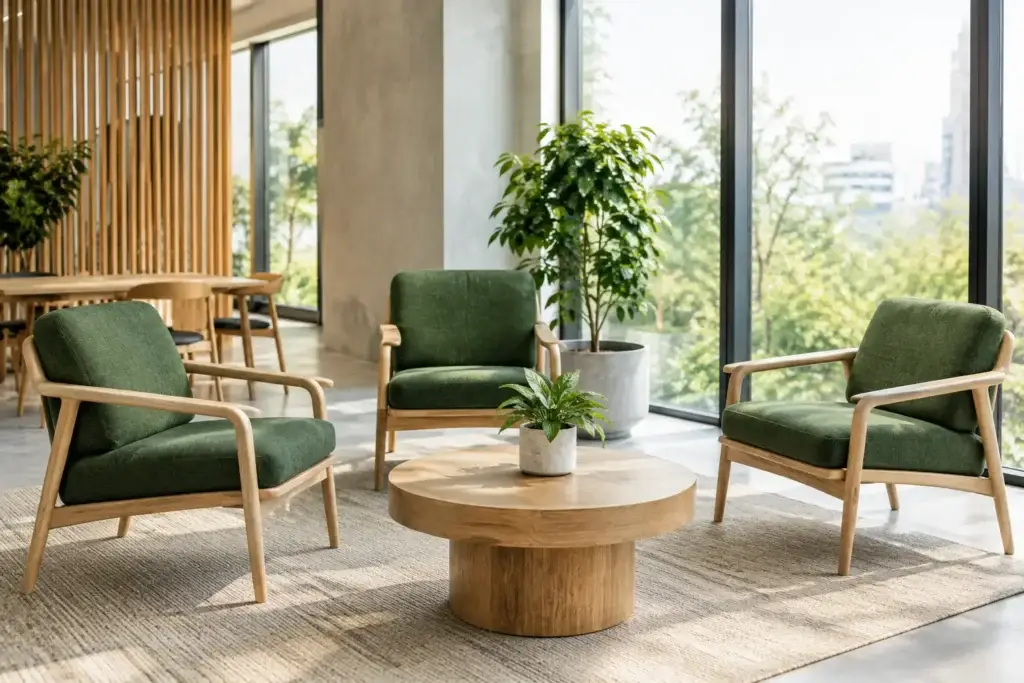
A hotel lobby chair that needs replacement after two years is not a sustainable purchase, regardless of how much recycled content it contains. For commercial buyers, sustainable contract furniture trends are moving beyond surface-level material claims and toward a more practical standard: furniture that performs under daily use, can be maintained or reconfigured, and supports responsible project delivery from specification through installation.
That shift matters because offices, restaurants, hotels, and public-facing environments place very different demands on furnishings than residential spaces. A sustainability strategy has to account for cleaning protocols, traffic levels, fire and code requirements, lead times, replacement planning, and the visual consistency of a multi-space project. The strongest results come from treating sustainability as a procurement and lifecycle decision, not a finish selection.
Sustainable Contract Furniture Trends Shaping Commercial Projects
Several trends are changing how architects, designers, facility teams, and business owners evaluate commercial furniture. While each project has different priorities, the common direction is clear: buyers want traceable materials, longer service life, and fewer gaps between design intent and operational reality.
Durability is becoming a sustainability requirement
The most meaningful sustainable decision is often specifying furniture that remains in service longer. Contract-grade frames, reinforced joinery, tested seating, high-performance textiles, and replaceable components reduce the likelihood that a space will require a premature full replacement.
This is especially relevant in restaurants and hospitality settings, where seating may be moved, cleaned repeatedly, exposed to spills, and used continuously throughout long operating hours. In offices, task seating and workstations need to withstand daily adjustment, changing teams, and reconfiguration. Choosing a lower-cost item that fails early can create higher material use, labor expense, and operational disruption than investing in a better-built alternative.
Durability does not mean every piece must be oversized or overengineered. It means matching construction and performance specifications to the environment. A private executive office, a busy hotel breakfast area, and an outdoor dining terrace each require a different level of wear resistance and maintenance planning.
Circular design is moving from concept to specification
Circular furniture design focuses on keeping products and materials useful for as long as possible. In commercial applications, this often takes the form of modularity, repairability, replaceable upholstery, removable cushions, standardized hardware, and components that can be renewed without replacing the full piece.
For a restaurant, that might mean selecting booth seating with serviceable upholstery panels or table bases that can accept new tops during a renovation. For an office, it may mean workstation systems that can expand, reduce, or move with changing headcount. In hospitality, replaceable guest room components can help a property refresh selected elements without discarding a coordinated furniture package.
The trade-off is that circular features need to be planned at the front end. A replaceable part only delivers value if dimensions, finishes, and service expectations are documented. Buyers should also ask whether replacement components can be supplied at a reasonable minimum quantity and within a practical lead time.
Recycled and renewable materials need better context
Recycled metals, recycled-content fabrics, rapidly renewable materials, responsibly sourced wood, and lower-impact surface options are now common points of discussion in furniture specifications. These materials can contribute to a stronger sustainability strategy, but content percentages alone do not tell the whole story.
A chair with recycled material still needs to meet the durability, cleanability, and safety needs of the project. Likewise, a wood surface should be evaluated for its source, coating system, repair potential, and suitability for the intended use. Commercial teams are increasingly asking for documentation that helps them compare materials in context rather than relying on broad environmental language.
Useful documentation may include chain-of-custody information for wood, material health disclosures, recycled-content reporting, product lifecycle information, and third-party certifications where applicable. These documents are not interchangeable, and not every project requires every credential. Their value depends on the client’s sustainability goals, certification targets, and reporting requirements.
Low-emitting interiors are influencing finish selections
Indoor environmental quality has become a more active consideration in workplace, education, healthcare-adjacent, and hospitality projects. Furniture can contribute through adhesives, coatings, composite wood, upholstery treatments, foam, and other interior components.
For specifiers, the practical task is to request clear information on emissions and product composition early enough to avoid late substitutions. This is particularly important when a project is pursuing formal building standards or when the client has internal wellness and material policies. A finish that looks right in a sample review may not satisfy the full performance and documentation requirements once it reaches the submittal stage.
There are limits to what any single product can accomplish. Indoor air quality is affected by the entire build-out, including flooring, paint, millwork, ventilation, cleaning products, and construction practices. Furniture should be part of a coordinated approach rather than treated as a standalone solution.
Localized and coordinated sourcing reduces project friction
Sustainability is also showing up in how projects are sourced and delivered. Consolidating furniture categories, coordinating finishes across spaces, and planning shipments around installation schedules can reduce excess handling, packaging, and last-minute freight decisions. For commercial clients, these practices also improve accountability.
Fragmented sourcing creates a familiar problem: multiple vendors, inconsistent lead times, unmatched finishes, separate receiving requirements, and unclear responsibility when something arrives damaged or incomplete. A coordinated furniture partner can help align design, manufacturing, logistics, and installation planning so that sustainable intent is not lost during execution.
Local or regional manufacturing can be beneficial when it supports reliable quality control and reduces unnecessary transportation. However, proximity alone does not make a product sustainable. Buyers should weigh origin alongside material selection, manufacturing practices, product longevity, and the supplier’s ability to support the project after delivery.
How to Evaluate Sustainable Furniture for a Real Project
The best specifications begin with operational questions, not marketing labels. Before approving a product, project teams should establish how the space will be used, who will maintain it, what performance standards apply, and how long the furniture is expected to remain in service.
Start by identifying the high-impact categories. Seating, casegoods, workstations, tables, and upholstered pieces typically deserve the closest review because they represent major material volume, frequent use, or both. Then evaluate each category through four connected lenses: expected lifespan, material documentation, maintenance requirements, and replacement strategy.
Expected lifespan should reflect the actual setting. A lounge chair in a quiet corporate reception area may have a different replacement cycle than a dining chair in a high-turnover restaurant. Material documentation should support the project’s stated goals without creating unnecessary administrative burden. Maintenance requirements should be realistic for the client’s staff and cleaning methods. Finally, the replacement strategy should address what happens when an upholstery panel, tabletop, glides, or seating component needs service.
This process also helps prevent a common procurement mistake: specifying sustainable-looking products that are difficult to maintain. Natural finishes, textured textiles, and lighter color palettes may support a design concept, but they need to be compatible with the cleaning program and traffic pattern. A more resilient finish or textile may be the responsible choice if it avoids early replacement.
Design Flexibility Matters as Much as Material Choice
Commercial interiors rarely stay fixed. Restaurants adjust seating mixes, offices add collaboration zones, hotels renovate in phases, and mixed-use properties adapt shared spaces as tenant needs change. Furniture that supports these changes can reduce future waste and preserve more of the original investment.
Modular lounge seating, movable partitions, adaptable workstations, and custom banquettes designed around accessible service zones can all support a longer useful life. Custom manufacturing is particularly valuable when standard products do not fit the dimensions, circulation needs, or brand requirements of the space. A piece designed correctly for its location is less likely to be replaced simply because it was a compromise from the start.
FOH Furniture approaches this through coordinated planning, custom manufacturing, and commercial furniture packages that consider the complete environment rather than isolated products. That approach allows project teams to balance sustainability goals with the realities of budget, code compliance, visual standards, and installation schedules.
Sustainable Contract Furniture Trends Require Better Questions
The market is full of environmental claims, but commercial buyers do not need more labels. They need answers that help them make durable decisions: What is this product made from? How will it perform in this setting? Can it be repaired, refinished, or reupholstered? What documentation is available? Can matching components be obtained later?
Those questions create better projects because they connect sustainability to the actual life of the furniture after opening day. When a specification is built around performance, serviceability, and coordinated execution, it can support both the client’s environmental priorities and the long-term demands of the space.