
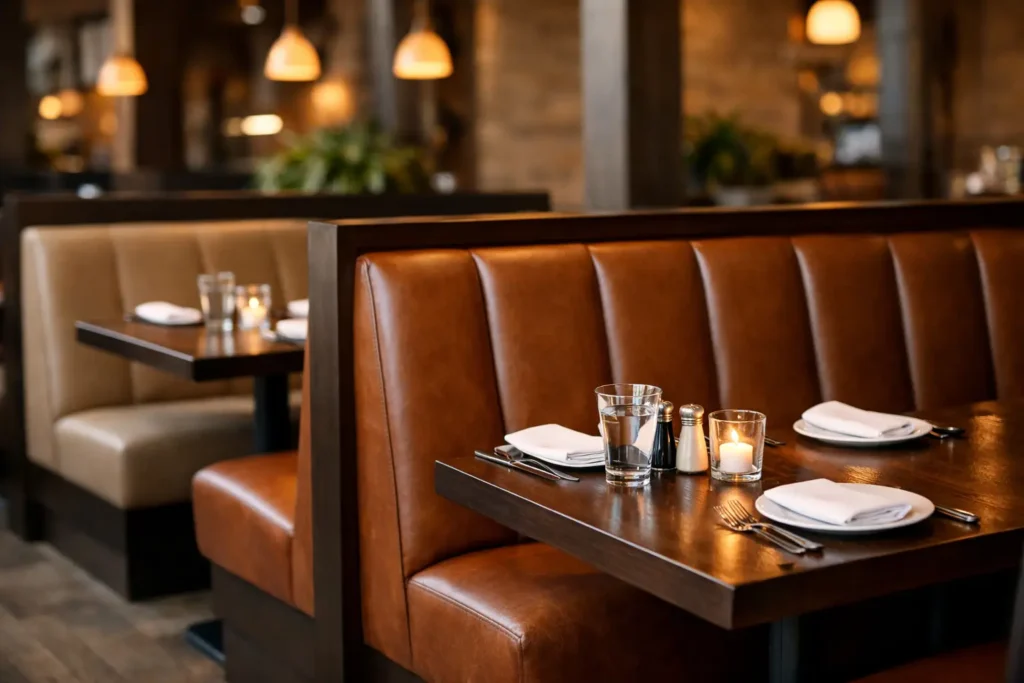
Restaurant Booth Seating That Works Hard
A few inches in booth depth or aisle clearance can change how a dining room performs. Restaurant booth seating is not just a style decision. It affects guest comfort, server flow, cleaning routines, table turns, and how many seats a floor plan can support without feeling crowded.
For operators, designers, and project teams, that makes booth selection a planning decision as much as a furniture decision. The right specification supports the brand, fits the footprint, and holds up under constant use. The wrong one creates layout bottlenecks, premature wear, and a space that looks finished on opening day but becomes difficult to maintain six months later.
Why restaurant booth seating matters in commercial layouts
Booths do several jobs at once. They define space, create visual order, and give guests a sense of privacy that freestanding tables often cannot match. In many restaurant concepts, they also improve seat density along perimeter walls or in center-floor runs where a consistent seating module makes the layout easier to plan.
That said, higher seat count is only valuable when the layout still works operationally. A booth that saves floor space on paper may create problems if the table size is underspecified, the back height blocks sightlines, or the aisle between runs is too tight for service traffic. This is where commercial planning matters. Booth seating should be evaluated as part of the full room, not as an isolated product category.
The best outcomes usually come from balancing four priorities: capacity, comfort, durability, and brand fit. Casual dining, fast casual, hotel foodservice, and upscale concepts will each weight those factors differently. A quick-service concept may prioritize efficient turnover and easy-clean upholstery. A higher-end dining room may accept a larger booth footprint in exchange for comfort and acoustic softness.
Choosing the right restaurant booth seating for the concept
There is no single best booth for every restaurant. The right solution depends on service model, guest stay duration, menu price point, and available square footage.
Single booths placed along walls are often the most efficient starting point. They make good use of perimeter space and allow designers to pair consistent table sizes across a room. Double booths can increase density in larger footprints, but they require careful planning around circulation and table alignment. L-shaped and U-shaped booths are effective when the goal is to anchor corners or create group seating zones, though they demand more custom coordination and can limit flexibility if the floor plan changes later.
Back height is another decision that should match the concept. Lower backs keep the room visually open and can help smaller spaces feel less segmented. Higher backs offer more privacy and can improve acoustics, but they may make the room feel heavier if used everywhere. In some projects, a mix works best, with perimeter runs using one profile and focal areas using another.
Seat feel also deserves more attention than it usually gets during early planning. Overly soft seating may feel attractive in a showroom but can break down faster in a commercial environment and make ingress and egress awkward for guests. A firmer, properly supported seat often performs better over time, especially in restaurants with high traffic and a wide demographic range.
Materials, construction, and long-term performance
Commercial booth seating lives through constant abrasion, spills, repeated cleaning, and shifting loads. That is why construction quality matters more than surface appearance alone.
The frame should be built for repeated use, with stable joinery and materials appropriate for a high-traffic interior. In many projects, the conversation starts with upholstery, but the internal build is what determines whether a booth keeps its shape and support after heavy service. Weak foam, low-grade substrates, or poorly reinforced corners can shorten the life of the installation even if the finish initially looks acceptable.
Upholstery selection should be driven by maintenance realities. Vinyl and performance-coated materials are common because they simplify cleaning and hold up well in family dining, fast casual, and other high-turn settings. Textiles can bring warmth and a more elevated look, but they are not always the right answer for concepts with frequent spills or intensive daily sanitation. It depends on the environment, staffing, and maintenance standards.
Base design matters too. Fully enclosed bases can create a clean, built-in look, but they need to be detailed in a way that does not trap debris or complicate floor cleaning. Exposed legs can lighten the visual profile and improve access for cleaning, though they may not fit every brand aesthetic. The practical question is simple: how will this booth perform at 10 p.m. during cleanup, not just at the design presentation.
Dimensions that affect comfort and operations
Restaurant booth seating succeeds or fails in the details. Small dimensional errors tend to show up quickly once the space opens.
Seat height has to relate properly to table height. If that relationship is off, guests feel it immediately, even if they cannot explain why. Seat depth also needs balance. Too shallow, and the booth feels rigid. Too deep, and shorter guests lose back support. Table overhang, edge profile, and pedestal placement all influence how easy it is to sit down and dine comfortably.
Clearance is just as important as the booth itself. Servers need room to pass through aisles without constant interruption. Guests need enough space to enter and exit without dragging adjacent traffic to a halt. In dense floor plans, a booth layout can look efficient in CAD and still feel cramped in use. Mockups and plan review help catch this before fabrication.
This is one reason many commercial buyers prefer to work through a coordinated furnishing process rather than sourcing booths separately from tables and layout planning. Dimensions are interdependent. When seating, tables, and room flow are considered together, the result is easier to specify and easier to operate.
Custom booth seating vs. standard models
Standard booth models can be the right choice when lead times are tight, the footprint is straightforward, and the design intent does not require unusual dimensions or finish coordination. They simplify procurement and can keep a project moving.
Custom restaurant booth seating becomes more valuable when the concept has specific branding requirements, nonstandard room conditions, or a need to coordinate multiple finish and sizing variables. Curved walls, banquette runs, mixed upholstery programs, integrated divider panels, and precise seat-width targets often push a project beyond what stock models can solve well.
Custom does not automatically mean excessive or complicated. In many cases, it is the more efficient path because it reduces field adjustments, improves fit, and helps align the seating package with the rest of the interior. The real question is whether the project benefits from tailored specifications enough to justify the additional coordination.
For multi-unit operators and trade teams, consistency also matters. If a booth design needs to be repeated across locations, a controlled custom program can support brand standards while still allowing for site-specific adjustments where needed.
Booth seating and the larger furnishing package
A booth should not be selected in isolation from the rest of the restaurant. It needs to work with the table program, loose seating, bar stools, traffic paths, and overall visual balance of the space.
This is where project-oriented sourcing has an advantage. When booths are part of a broader furniture package, finish coordination is easier, dimensions are checked against the full plan, and procurement tends to be more controlled. That is especially useful for hospitality groups, restaurant owners, and design teams managing opening schedules and multiple stakeholders.
FOH Furniture approaches booth seating this way, as part of a coordinated commercial solution rather than a standalone item. That matters when a project calls for custom sizing, finish consistency, and practical support from planning through delivery.
Common specification mistakes to avoid
The most common mistake is prioritizing appearance over use conditions. A booth may match the renderings perfectly and still underperform if the upholstery is wrong for the cleaning protocol or if the seat construction is too light for the traffic level.
Another issue is underestimating how booth geometry affects service. Tight spacing, oversized table tops, or inconsistent module dimensions can slow down staff and create an uneven guest experience. These are not minor details. They affect labor efficiency and perceived comfort every day.
It is also common to overlook replacement planning. In busy commercial environments, finishes and cushions eventually need service. Choosing a booth program that can be maintained, repaired, or replicated later is often more valuable than choosing one that simply looks distinctive at install.
The best restaurant booth seating earns its place long after the opening photos are taken. It should support the pace of service, reinforce the concept, and make the room easier to run. If the specification does all three, the booth is not just filling space. It is helping the business perform better.

Furnishing a Commercial Space?
Let’s bring your vision to life with furniture that is durable, compliant, and built for real-world performance.
Planning a Commercial Furniture Project?
- Expert Project Guidance
- Competitive Pricing
- Quality You Can Trust


