
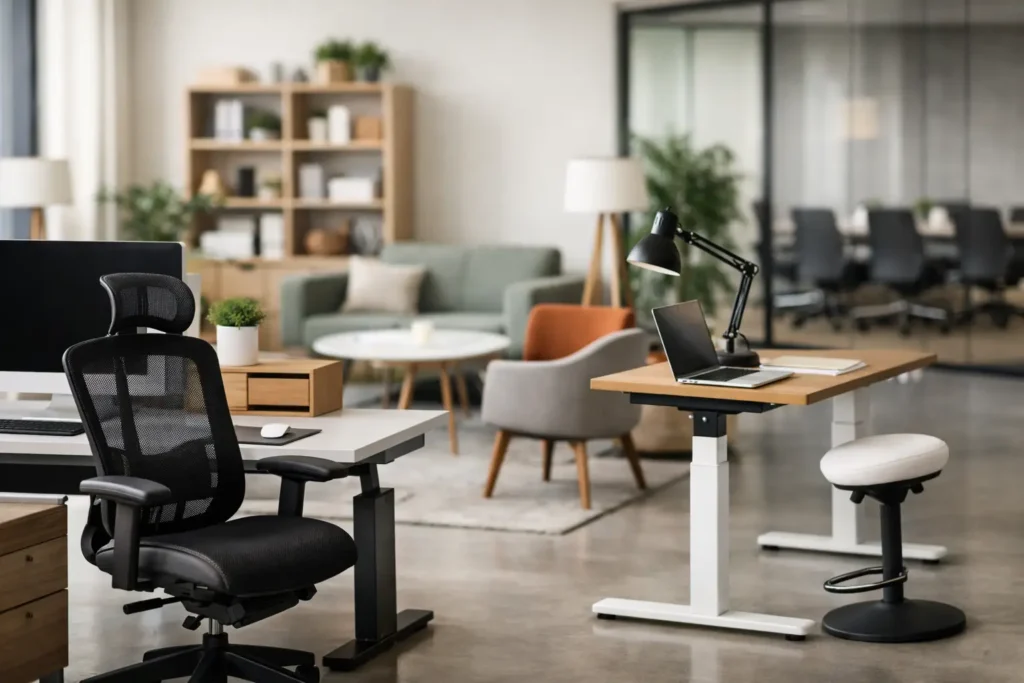
12 Office Furniture Examples That Fit Real Work
A growing team can outgrow its furniture long before it outgrows its square footage. That is usually when buyers start searching for office furniture examples – not to see random products, but to understand which pieces actually support workflow, employee comfort, and a clean installation across the full space.
For commercial projects, furniture selection is rarely about one desk or one chair. It is about how individual pieces work together across private offices, open-plan work areas, meeting rooms, reception zones, break areas, and support spaces. The right package improves circulation, reinforces brand standards, and holds up under daily use. The wrong mix creates layout problems, uneven finishes, and replacement costs that show up sooner than expected.
Office furniture examples by workspace function
The most useful way to review office furniture is by application. A workstation used eight hours a day has different performance requirements than a reception chair or a storage credenza in a private office. Looking at the category in context helps buyers specify better and avoid overbuying or underbuilding.
1. Bench workstations
Bench workstations are a common choice for open offices where efficiency and team adjacency matter. They typically place multiple users in a shared footprint with dividing screens, shared power access, and coordinated surface finishes.
This format works well for departments that collaborate frequently and need a high seat count without filling the floor with fully enclosed stations. The trade-off is privacy. If concentration and acoustic control are major concerns, benching may need added panels, nearby focus rooms, or a different workstation strategy.
2. Executive desks
Executive desks are designed for private offices where presentation, storage, and a more substantial visual profile are part of the requirement. These desks often include larger work surfaces, integrated credenzas, premium laminates or veneers, and options for cable management.
They are a strong fit for leadership offices, client-facing environments, and spaces where furniture needs to reflect the company image. The key is not to overspecify. In some offices, a simpler private-office desking system can perform just as well while keeping the overall package more consistent with adjacent work areas.
3. Height-adjustable desks
Height-adjustable desks continue to gain traction in commercial environments because they support movement and user flexibility. They are especially valuable in assigned workstations, management offices, and departments where employees spend long periods at a computer.
Not every project needs every desk to be adjustable. Budget, power access, and user needs all matter. In some installations, a mixed approach makes more sense, with adjustable desks in selected zones and fixed desks elsewhere.
4. Task chairs
Among all office furniture examples, task chairs may have the biggest effect on day-to-day usability. A commercial task chair should offer proper ergonomic adjustment, durable upholstery or mesh, and performance suited to high-frequency use.
This is one category where consumer-grade products tend to fall short. In a commercial setting, chairs need to withstand repeated daily use by multiple users over time. Seat comfort matters, but so do weight ratings, mechanism quality, warranty support, and finish coordination with the rest of the project.
5. Guest and side chairs
Guest chairs serve private offices, meeting rooms, waiting areas, and touchdown spaces. They may look simple, but they carry a lot of responsibility. They need to be comfortable enough for a meeting, durable enough for turnover, and visually aligned with the broader environment.
For some projects, stackability or easy mobility is essential. For others, the focus is on a more tailored appearance. The best specification depends on how the space is actually used, not just how it appears on a floor plan.
6. Conference tables
Conference tables anchor meeting rooms and often shape how the room functions. Standard examples include boat-shaped tables, rectangular tables, modular training tables, and larger custom tables built around room dimensions and technology requirements.
A conference table should be selected with chairs, screen placement, and power access in mind. A table that looks right in isolation can create problems if users cannot move around it comfortably or if cords end up stretched across the floor. In many projects, custom sizing is worth considering because meeting rooms rarely fit standard dimensions perfectly.
7. Reception desks
Reception desks have both operational and brand value. They need to support check-in, storage, accessibility, and front-of-house organization while presenting a polished first impression.
For commercial buyers, this is often where custom work becomes especially useful. Standard desks can serve some spaces, but reception areas frequently need specific dimensions, material combinations, transaction counters, or logo integration. A purpose-built desk can solve circulation and presentation issues at the same time.
8. Filing and storage systems
Storage is less visible than desks and seating, but it directly affects how usable the office remains over time. Common solutions include lateral files, mobile pedestals, overhead storage, bookcases, lockers, and credenzas.
The right mix depends on how much paper the team still handles, what needs to be secured, and whether storage should stay personal or become shared. Many offices need less filing than they once did, but that does not mean storage is optional. It usually shifts toward mixed-use storage for supplies, devices, personal items, and departmental materials.
Office furniture examples for shared and support spaces
Office projects are not limited to desks and conference rooms. Shared spaces now carry more of the workplace load, especially in offices designed around flexibility, recruitment, and cross-functional use.
9. Collaborative tables
Collaborative tables are used in open meeting zones, project rooms, touchdown areas, and informal huddle spaces. They can be standing height, seated height, or counter height depending on the intended use.
These tables are effective when teams need quick gathering points without booking a formal conference room. The finish and base style should still align with the overall furniture package. If collaborative zones feel disconnected from the rest of the office, the space can start to look pieced together rather than intentionally planned.
10. Lounge seating
Lounge seating includes club chairs, modular soft seating, loveseats, and occasional tables used in waiting areas, breakout zones, executive suites, and amenity spaces. In a commercial office, these pieces need more than residential style. They need contract-grade construction and materials suitable for sustained use.
Lounge furniture can make a workplace more flexible and more inviting, but it should be placed carefully. Soft seating is excellent for short meetings, waiting areas, and casual conversation. It is less effective where users need long-duration support for laptop work unless paired with appropriate tables and power access.
11. Training room furniture
Training spaces often need modularity first. Folding tables, mobile tables, nesting chairs, and reconfigurable layouts allow one room to support instruction, onboarding, group sessions, and presentations.
This is a category where mobility and storage matter just as much as appearance. If furniture cannot be moved and reset efficiently, the room loses value. Durable casters, straightforward handling, and consistent dimensions make a major difference in spaces that change often.
12. Breakroom and cafe furniture
Breakroom furniture includes dining-height tables, cafe chairs, counter stools, banquettes, and occasional communal tables. These pieces shape how employees use support spaces and whether those spaces feel functional or improvised.
Commercial buyers should look at cleanability, edge durability, and layout density. A break area that is too tight becomes frustrating during peak use. One that is oversized at the expense of work areas may not be the best use of square footage. Balance matters.
What to evaluate beyond the furniture itself
Reviewing office furniture examples is only the first step. The stronger decision usually comes from evaluating how each piece performs within a full project scope.
Specification should account for traffic levels, maintenance expectations, finish consistency, lead times, and installation logistics. It should also address how furniture categories connect. A private office package should not feel disconnected from the conference rooms. Reception should not look like it came from a different project than the workstations. Cohesion matters because it affects both visual quality and procurement efficiency.
Customization also deserves a practical lens. Custom furniture is not only about making something look unique. In commercial work, it often solves dimensional problems, aligns branding across multiple zones, and helps teams avoid forcing standard products into nonstandard spaces. That can be especially valuable in projects with specific floor plans, phased installations, or mixed-use business environments.
For many buyers, the bigger issue is coordination. Sourcing desks from one supplier, chairs from another, and front-of-house pieces from a third can create finish mismatches and schedule gaps. A more integrated approach reduces that risk and gives designers, contractors, and business owners a clearer path from planning through delivery. That is one reason companies such as FOH Furniture position furnishing as a project solution rather than a product-only transaction.
The best office furniture package is not the one with the most pieces. It is the one that fits the way the business actually operates, supports users across different zones, and stays consistent from specification to installation. If you are reviewing options, start with the spaces that carry the most daily demand, then build the package around function, durability, and coordination. Good furniture fills a room. The right furniture helps the whole project work.

Furnishing a Commercial Space?
Let’s bring your vision to life with furniture that is durable, compliant, and built for real-world performance.
Planning a Commercial Furniture Project?
- Expert Project Guidance
- Competitive Pricing
- Quality You Can Trust


