
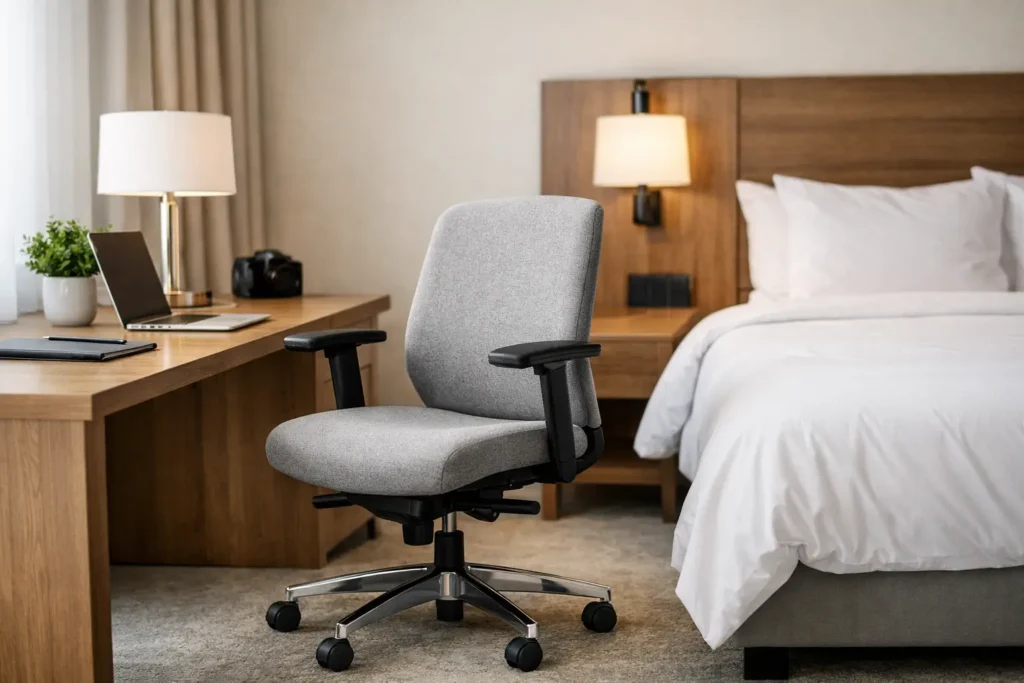
How to Choose Hotel Task Chairs for Guest Rooms
A hotel task chair can occupy only a few square feet, yet it affects the guest experience every day. In-room desks increasingly serve business travelers, families planning itineraries, and guests who need a comfortable place to work between meetings. Knowing how to choose hotel task chairs means looking beyond a chair’s appearance to evaluate ergonomics, durability, room fit, operational needs, and brand consistency.
For hospitality projects, the right specification is rarely the lowest-cost chair or the most feature-heavy office model. It is the chair that performs reliably in the intended room type, supports the property’s design direction, and can be maintained or replaced without disrupting operations.
Start With the Guest Room and Its Intended Use
Task chairs should be selected in the context of the full guest room plan, not as an isolated furniture purchase. Begin with the desk dimensions, available clearance, flooring type, lighting, luggage paths, and the placement of beds, nightstands, and lounge seating. A chair that looks appropriately scaled in a showroom can make a compact room feel congested once it is positioned under a desk.
Consider who will use the workstation and for how long. In an airport hotel or select-service property, guests may use the desk for brief laptop sessions, boarding passes, or meals. A streamlined chair with essential ergonomic support may be appropriate. In an extended-stay, convention, or business-focused hotel, guests may work for several hours at a time. Those environments generally justify stronger adjustability, better lumbar support, and a more substantial seat construction.
The chair should also align with the property’s room hierarchy. Standard rooms, suites, executive floors, and accessible rooms can require different task-chair specifications. A coordinated family of chairs can preserve visual consistency while allowing each room type to receive the level of support and finish quality it needs.
Prioritize Commercial Ergonomics, Not Office Complexity
Guests come in a wide range of heights, body types, and mobility levels. At minimum, hotel task chairs should provide a supportive seat, a stable base, and a height range that works with the installed desk. A pneumatic height-adjustment mechanism is often useful, especially when desks are designed around a conventional work height.
More adjustment is not always better. Highly adjustable office chairs can be appropriate in premium suites or long-stay accommodations, but too many levers and controls may confuse guests and complicate maintenance. In many hotel rooms, a simple, intuitive chair with a contoured back and dependable tilt function delivers the better balance of comfort and operational practicality.
Seat depth deserves close attention. A seat that is too deep can put pressure behind shorter guests’ knees, while a shallow seat may feel inadequate for larger users. Look for proportional dimensions that accommodate a broad guest population without overpowering the room. Waterfall seat edges can help reduce pressure at the front of the thighs during longer periods of sitting.
Armrests require a project-specific decision. Armless task chairs slide fully beneath desks and simplify circulation in smaller rooms. Chairs with arms can provide added comfort, but they must clear the desk apron and avoid interfering with guests as they enter or exit the chair. If arms are specified, confirm their height and width against the actual desk design rather than relying on a general product drawing.
Match the Chair Base to the Floor Surface
A five-star base provides stable support and is common for task seating, but casters should be selected for the room’s flooring. Hard casters can damage some hard-surface floors or create unwanted rolling on smooth luxury vinyl tile. Soft casters may be better suited to hard flooring, while carpeted rooms may need casters designed to move effectively over pile height.
Glides are another option for rooms where the chair is intended to remain in a fixed position or where rolling creates operational concerns. They can reduce movement and simplify housekeeping, although they are less convenient for guests who regularly reposition the chair. The right answer depends on room layout, flooring, and how the desk is expected to be used.
Specify Materials for Housekeeping and Long-Term Wear
Hotel furniture experiences a different wear pattern from office furniture. Task chairs must withstand frequent turnover, luggage contact, cleaning products, spilled beverages, and occasional misuse. Materials should be selected for cleanability and replacement planning as much as visual appeal.
Performance textiles can bring warmth and residential character to a guest room, especially when they meet commercial abrasion, stain-resistance, and cleanability requirements. However, light-colored woven fabrics may show staining quickly in high-turnover properties. Vinyl, polyurethane, and other cleanable upholstery options can be practical choices, particularly where housekeeping efficiency is a priority. Their hand feel, appearance, and temperature response vary widely, so review physical samples rather than specifying from a screen.
Mesh backs can offer breathable comfort and a lighter visual profile, but they need to be evaluated for snag resistance, edge durability, and suitability for the property’s design concept. Upholstered backs often create a more tailored hospitality look and can connect the task chair to headboards, banquettes, or window treatments. The trade-off is that they may require more deliberate fabric selection and cleaning protocols.
Frame finishes should withstand scratches and routine cleaning. Powder-coated metal, durable plated finishes, and properly specified wood components can all work well, depending on the design direction. Avoid relying on decorative materials that look attractive at installation but are difficult to touch up, clean, or source again after several years.
Confirm Dimensions, Clearances, and Accessibility Early
A task chair should allow the guest to sit, move, and access other room functions comfortably. Verify the overall width, depth, back height, seat height range, and arm dimensions against the furniture plan. Include the chair’s movement zone, not just its parked footprint beneath the desk.
This review is particularly important in compact rooms. A chair that projects too far into the circulation path can create conflict with the bed, closet, entry door, or minibar. It may also make it harder for housekeeping staff to service the room efficiently. Full-scale mockups or sample-room installations are useful when dimensions are tight or when custom desk millwork is involved.
Accessibility should be addressed at the planning stage. Depending on the project and applicable requirements, accessible guest rooms may need work surfaces and seating arrangements that support clear floor space and usable approach. The task chair should not become an obstacle to an accessible desk or compromise the flexibility needed by guests with mobility devices.
Coordinate the Chair With the Hotel Brand
Task seating is a functional item, but it is still part of the room’s visual story. A black mesh office chair may feel out of place in a boutique property built around warm woods, textured fabrics, and residential styling. Conversely, a fully upholstered accent chair may not provide enough mobility or support for a high-volume business hotel.
Use the chair to reinforce the brand’s design language through silhouette, upholstery, frame finish, and scale. A clean-lined chair with a matte metal base can support a contemporary urban hotel. A softly upholstered task chair may better suit an upscale or lifestyle concept. For branded portfolios, establish approved finish options that allow regional or property-specific variation without losing recognizable consistency.
Custom upholstery, finish matching, and coordinated furniture packages can help design teams avoid the fragmented look that often results from sourcing desks, seating, and casegoods independently. FOH Furniture supports this type of coordinated commercial planning with specification-oriented furniture solutions tailored to project requirements.
Evaluate the Supplier Beyond the Initial Quote
The purchase price matters, but it is only one part of the task-chair cost over its service life. Ask about weight capacity, warranty coverage, replacement parts, lead times, minimum order quantities, packaging, and finish consistency across production runs. A low-cost chair becomes expensive if it fails early, cannot be repaired, or is unavailable when rooms need replacements.
For multi-property programs, confirm whether the supplier can maintain approved specifications and provide repeatable production over time. For renovation projects, review delivery sequencing and staging requirements. Task chairs may be a small line item, but delayed or damaged seating can still hold up room turnover and opening schedules.
A reliable commercial partner should also be prepared to discuss mockups, fabric testing, custom options, and coordination with the broader furniture package. Those details reduce risk before purchase orders are released, when changes are far less costly than they are after installation.
Create a Specification That Can Be Maintained
The strongest hotel task-chair decisions are documented clearly. Record the approved model, upholstery or finish code, caster or glide type, dimensions, warranty information, cleaning guidance, and replacement-part details. Keep a finish sample and photographs of the installed chair with the property’s furniture standards.
This documentation helps purchasing teams reorder accurately, gives housekeeping and engineering departments appropriate care instructions, and protects the intended room design during future refreshes. It also prevents an apparently similar replacement chair from introducing the wrong height, color, or base configuration.
The best task chair is one guests use without thinking about it: comfortable at the desk, appropriate to the room, easy for staff to maintain, and dependable through years of occupancy. Selecting it with the same discipline applied to every other hospitality furnishing decision protects both the guest experience and the project’s long-term operating value.

Furnishing a Commercial Space?
Let’s bring your vision to life with furniture that is durable, compliant, and built for real-world performance.
Planning a Commercial Furniture Project?
- Expert Project Guidance
- Competitive Pricing
- Quality You Can Trust


