
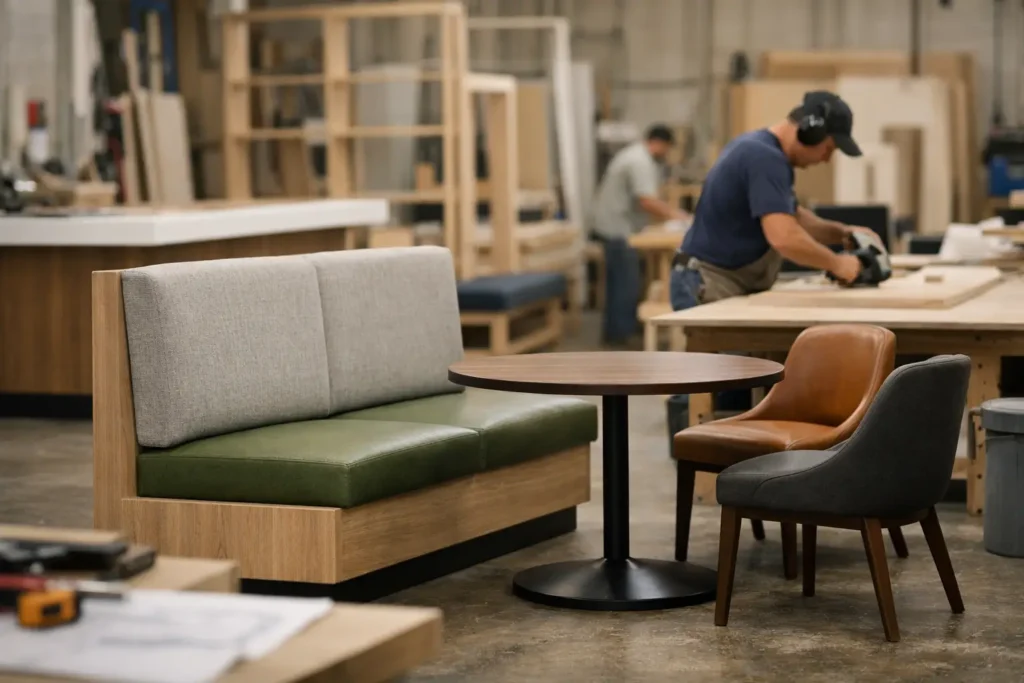
Custom Furniture Manufacturing for Commercial Spaces
A standard table spec looks fine on paper until it misses the aisle clearance by three inches, the finish conflicts with the brand palette, or the base cannot handle daily traffic in a busy dining room. That is where custom furniture manufacturing becomes a practical business decision, not a design extra. For commercial projects, the value is not just getting something unique. It is getting furniture that fits the space, supports operations, and holds up under real use.
Offices, restaurants, hotels, and mixed-use commercial environments rarely operate on standard conditions. Floor plans vary. Traffic patterns are different. Brand standards may be strict. ADA considerations, cleaning requirements, and installation sequencing all affect what furniture should be built and how it should perform. When buyers try to force an off-the-shelf solution into a project with specific constraints, the result is usually compromise somewhere else in the plan.
Why custom furniture manufacturing matters in commercial projects
In commercial furnishing, customization is less about novelty and more about alignment. A restaurant may need booth seating that maximizes capacity without making service circulation difficult. A hotel may need casegoods and seating that reflect brand standards while meeting durability requirements across multiple rooms and public areas. An office may need workstations, storage, and conference furniture sized to an exact layout so the space functions properly from day one.
Custom furniture manufacturing gives project teams control over dimensions, materials, finishes, upholstery, edge details, and construction methods. That control matters because commercial spaces are judged on more than appearance. They are judged on throughput, maintenance, comfort, and how efficiently the environment supports staff and guests.
There is also a procurement advantage. Instead of sourcing from several vendors and trying to coordinate finish matches, dimensions, lead times, and freight across separate orders, a custom manufacturing approach can consolidate decision-making. That tends to reduce avoidable mismatches and helps keep the project moving with fewer surprises during installation.
Where standard furniture falls short
Standard product lines still have a place in commercial furnishing. They can work well for straightforward applications, especially when timelines are compressed and the layout is flexible. But they often break down when a project needs consistency across multiple furniture types or when the space has unusual requirements.
A common issue is scale. Standard sizes may be close, but close is not the same as correct in a commercial environment. Banquettes that are too deep affect table spacing. Desks that are too large limit circulation. Outdoor seating that looks appropriate in a catalog may not withstand the local exposure conditions or usage volume.
Another issue is visual coordination. Designers and owners often need a unified package across private offices, open work areas, reception zones, restaurant seating, lounge spaces, and outdoor areas. Pulling those pieces from unrelated manufacturers can create inconsistencies in finish tone, detailing, and overall quality level. That may not seem critical early in procurement, but it becomes obvious once the installation is complete.
Then there is performance. Commercial furniture has to meet a higher standard than residential-style product adapted for business use. Traffic, cleaning frequency, spill exposure, stacking needs, and repeated movement all affect what should be specified. Custom manufacturing allows those realities to shape the product before it is built rather than after it starts failing in use.
What a strong custom process should include
The quality of a custom result depends as much on process as on craftsmanship. Commercial buyers need more than a shop that can build to order. They need a partner that can translate operational requirements into buildable, specification-ready products.
The process usually begins with space planning, project goals, and application details. That means understanding how the furniture will be used, who will use it, how often it will be cleaned or moved, and what the project timeline requires. A well-run manufacturer does not jump straight to finishes. They ask about site conditions, code-related constraints, wear expectations, and installation logistics.
From there, design development and specification refinement become critical. Dimensions should be confirmed against real layouts, not estimated from idealized plans. Material options should be evaluated based on traffic, maintenance, and budget, not just appearance. Upholstery, laminate, veneer, metal, and solid surface choices all involve trade-offs. A premium finish may elevate the presentation but increase lead time or maintenance sensitivity. A more practical material may perform better long term while still meeting the design intent.
Prototyping or shop drawings can also be important, especially for larger projects or repeated furniture programs. They allow stakeholders to review details before production begins. That step helps reduce scope confusion and gives owners, designers, and contractors a shared reference point.
Custom furniture manufacturing in offices, hospitality, and restaurants
Commercial furniture needs vary by sector, which is why a one-size-fits-all approach rarely performs well across project types.
Office environments
In office settings, custom furniture manufacturing often supports workstation planning, executive offices, conference rooms, reception areas, and collaborative spaces. The main priority is usually fit – both physical fit within the floor plan and functional fit for the way teams work. Storage needs, cable management, privacy requirements, and brand presentation all factor into the specification.
An office project may also require furniture packages that balance custom anchor pieces with standardized supporting items. That approach can control budget while still delivering a cohesive environment.
Restaurant spaces
Restaurants place a different kind of pressure on furniture. Seating density, guest comfort, service flow, and cleanability tend to drive the specification. Booths, communal tables, bar-height elements, and outdoor dining pieces often need exact sizing to support both revenue and operations.
In these spaces, custom work is frequently the difference between a floor plan that performs well and one that looks good but creates daily friction. Small dimensional changes can improve circulation, increase usable seating, and simplify maintenance.
Hospitality applications
Hotels and hospitality environments usually demand a broader package – guest room furniture, lobby seating, dining pieces, casegoods, and public-area furnishings that align with the property identity. Consistency matters, but so does durability across multiple touchpoints.
Hospitality buyers also tend to care deeply about repeatability. If furniture is specified for one property or one phase, they may need the ability to reproduce that package later. A capable manufacturing partner should be able to support that continuity with documented specifications and reliable production standards.
Balancing customization, budget, and lead time
Not every project needs full customization, and not every custom feature is worth the cost. The best commercial outcomes usually come from being selective. Critical dimensions, high-visibility statement pieces, and furniture tied closely to brand identity are often the right places to customize. Commodity-style pieces may not need the same level of design development.
Budget decisions should be made in relation to lifecycle value, not just unit cost. A cheaper product that needs early replacement, creates maintenance issues, or disrupts the layout can become more expensive over time. On the other hand, overengineering every piece can push a project beyond what is necessary.
Lead time is another variable. Custom furniture manufacturing generally requires more coordination than buying stock product, but that does not automatically mean it slows the project. In many cases, integrated planning and production can actually reduce delays caused by fragmented sourcing. The key is involving the manufacturing partner early enough to align drawings, approvals, materials, and site schedules.
How to evaluate a custom furniture manufacturing partner
Commercial buyers should look beyond finish options and sample photos. The real test is whether the manufacturer understands project execution.
A strong partner can discuss layout implications, material suitability, specification consistency, and delivery coordination with the same confidence they bring to fabrication. They should be comfortable working with designers, architects, contractors, and owners because commercial projects depend on coordination across all of those roles.
It also helps to evaluate range. A manufacturer that can support office, restaurant, hospitality, and outdoor applications under one roof is often better positioned to create consistency across a multi-space project. That is especially useful when a business wants a coordinated package rather than isolated purchases. FOH Furniture operates in that full-service model, combining custom manufacturing with planning and project support that commercial buyers often need.
Finally, ask practical questions. Can they build to exact specifications? Can they help refine dimensions for field conditions? Can they coordinate mixed furniture packages for one installation schedule? Can they guide trade-offs between aesthetic goals and durability requirements? Those are the questions that reveal whether a supplier is simply selling furniture or actively helping deliver the project.
Custom furniture manufacturing works best when it is treated as a project solution, not a specialty add-on. When the process is handled well, it improves fit, reduces sourcing friction, and gives commercial spaces furniture that supports the way the business actually operates. If the goal is a space that performs as well as it looks, customization is often the most efficient path to getting there.

Furnishing a Commercial Space?
Let’s bring your vision to life with furniture that is durable, compliant, and built for real-world performance.
Planning a Commercial Furniture Project?
- Expert Project Guidance
- Competitive Pricing
- Quality You Can Trust


