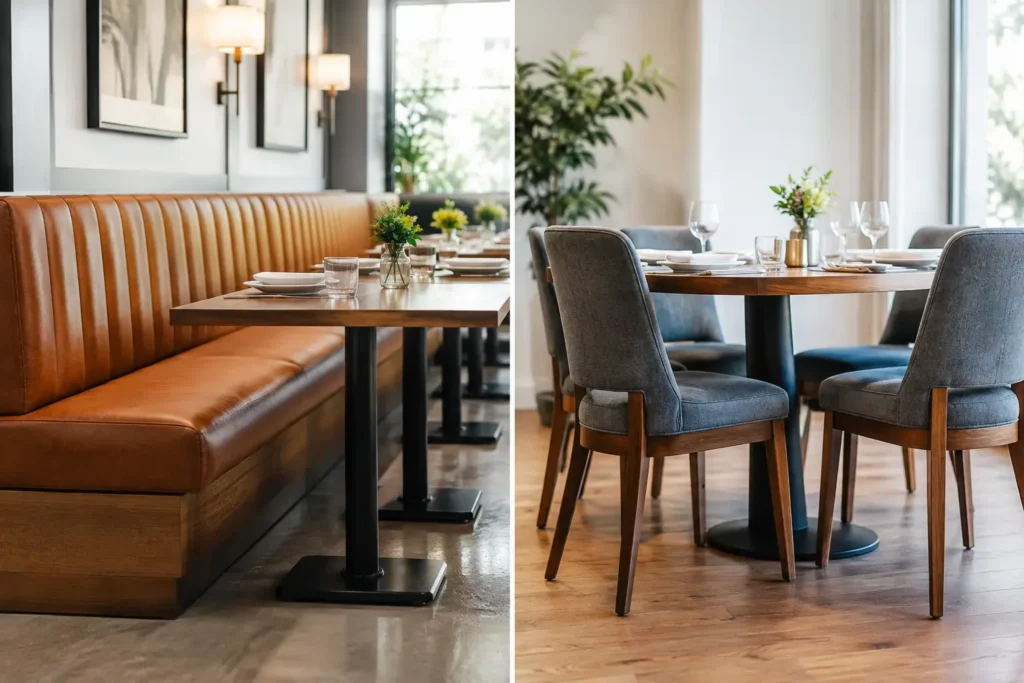
A banquette can make a 2,500-square-foot restaurant feel deliberate and efficient. The wrong one can make service aisles tight, cleaning difficult, and future reconfiguration expensive. When evaluating banquette seating vs dining chairs, commercial operators should start with the operating plan, not a design preference. The better choice depends on guest turnover, floor plan geometry, accessibility requirements, maintenance standards, and the level of flexibility the space needs after opening.
Start With the Service Model and Floor Plan
Dining furniture has to support the way a property earns revenue. A quick-service concept with a high lunch rush may value predictable seating capacity and easy table resets. A full-service restaurant may need a mix of intimate two-tops, flexible party seating, and comfortable perimeter dining that encourages guests to stay longer. In hospitality settings, the decision may be driven by how seating supports breakfast service, lobby traffic, private events, or all-day food and beverage use.
Banquettes work best where walls, columns, windows, or built-in architectural features already define the room. They turn perimeter space into usable seating and can create a clean visual line through the dining area. Dining chairs are more adaptable in the center of the room, around varied table sizes, and in locations where the layout may change for events or seasonal service.
Before specifying either option, confirm clearances for servers, guests, mobility devices, and emergency egress. A layout that looks efficient on a plan can become operationally frustrating if a seated guest blocks a major aisle or staff cannot comfortably approach a table. Furniture planning should account for the complete setting, including table bases, chair pull-back space, wall protection, and the path to restrooms, exits, and service stations.
Where Banquette Seating Earns Its Footprint
Banquette seating is a fixed or semi-fixed upholstered bench, typically installed along a wall or configured back-to-back in the center of a dining room. Its primary commercial advantage is space efficiency. A continuous bench can seat more guests along a wall than individual chairs while creating a consistent rhythm of tables.
For operators, that efficiency can support a stronger seat count without making the room look crowded. Banquettes also help define zones. A high-back booth can provide acoustic separation between neighboring tables, create privacy in a hotel lounge, or establish a branded dining moment in a restaurant. Upholstery, channeling, button details, wood caps, metal bases, and custom dimensions allow the seating to carry a property’s design language rather than functioning as a generic furnishing.
Capacity and guest comfort
A well-designed banquette uses its footprint productively, especially along long walls and in narrow rooms where chair clearance would waste valuable space. It can also be more forgiving for families and groups, since guests can slide together when needed. For breakfast rooms, casual dining concepts, and hospitality venues serving mixed party sizes, this can improve practical capacity during busy periods.
Comfort, however, is not automatic. Seat depth, back pitch, foam density, upholstery performance, and table placement all matter. A bench that is too deep makes dining awkward for shorter guests; one that is too upright can discourage longer stays. Commercial-grade construction and appropriately specified foam are essential where the seating will experience daily use.
Brand control and durability
Built-in seating gives designers and operators greater control over the room. It can conceal wall irregularities, coordinate with millwork, and create a polished installation that looks purpose-built. It also reduces the visual disorder that can occur when chairs are moved or left unevenly after service.
The trade-off is that a banquette is a project component, not simply a product placed on the floor. It requires field verification, coordination with electrical or architectural elements, defined installation conditions, and careful review of materials. If the upholstery is damaged, repair may require an on-site service approach rather than a quick chair replacement. Selecting cleanable commercial vinyl, high-performance textiles, durable wood finishes, and protected base details helps control that lifecycle burden.
When Dining Chairs Are the Better Commercial Choice
Dining chairs provide flexibility that fixed seating cannot. They can be repositioned for large parties, removed for private events, replaced individually after damage, and moved as a concept evolves. For restaurants that frequently change table configurations, event spaces that need multiple setups, or hotel outlets with variable dayparts, that flexibility can be worth more than the density advantage of a banquette.
Chairs also offer more individual comfort options. Armchairs can support longer meals and premium guest experiences, while lightweight side chairs can improve staff efficiency in high-turnover environments. Seat upholstery can be mixed with wood, metal, or molded shell construction to balance appearance, cleanability, and budget.
From a maintenance perspective, chairs simplify replacement planning. A facility team can pull one damaged chair from service and substitute a matching unit, provided the model remains available or the project includes attic stock. That is useful for multi-location operators and properties that need to maintain a consistent guest-facing standard with minimal downtime.
Their limitations are visible in dense layouts. Every chair needs room to pull back, and frequent movement can create noise, floor wear, and a less orderly appearance. Chair legs can also complicate cleaning, especially in foodservice settings where debris collects around table and seating bases. Glides, frame construction, and weight ratings should be specified for the actual flooring and service environment rather than selected on appearance alone.
Banquette Seating vs Dining Chairs: Key Specification Decisions
The most effective comparison is not fixed seating against loose seating in the abstract. It is a review of what each option does in a specific zone. Perimeter walls, window lines, and dead corners often favor banquettes. Open dining areas, private rooms, and multipurpose spaces usually benefit from chairs. Many successful commercial installations use both.
Seat count should be measured alongside revenue quality. Adding four seats is not an improvement if those seats create poor access, uncomfortable dining, or service bottlenecks. Conversely, a modestly lower count may be justified where chairs allow the room to accommodate a larger private party or create a more elevated hospitality experience.
Cleaning protocols deserve equal attention. Banquettes with closed bases can reduce debris underneath the seating, but seams, tufting, and difficult upholstery textures can hold spills if not chosen carefully. Chairs make it easier to access walls and floors, yet require staff to move them for thorough cleaning. For foodservice projects, specify materials and detailing that match actual sanitation routines, not idealized maintenance schedules.
Budget should also be evaluated as an installed, lifecycle cost. Banquettes often require higher upfront investment because they involve custom fabrication, field dimensions, freight coordination, and installation. Chairs may cost less to deploy initially, but large quantities can add up, particularly when premium frames, upholstery, and replacement inventory are required. The appropriate choice is the one that supports the operational model over time, not simply the lowest line item on a furniture quote.
Use a Hybrid Layout When the Program Calls for It
A hybrid approach often produces the strongest result. Banquettes can anchor the perimeter and provide visual structure, while chairs preserve flexibility at central tables. Back-to-back banquettes can create efficient rows of seating, with movable chairs at the table ends for adjustable party sizes. In a hotel restaurant, upholstered banquettes may define the signature dining area while loose chairs serve communal tables, private dining, and event functions.
This approach also reduces risk. If a space must open on a demanding timeline, a coordinated plan can prioritize fixed seating where it delivers clear value and use loose commercial chairs where late-stage adjustments are more likely. The key is to coordinate dimensions, finishes, table heights, bases, and traffic flow as one package rather than treating each furniture category separately.
For custom projects, FOH Furniture can help align seating selection with space planning, manufacturing requirements, material performance, and installation needs. That coordination is particularly valuable when a project includes restaurant seating, tables, booths, hospitality furnishings, and multiple room types under one procurement schedule.
The practical question is not whether banquettes or chairs are inherently better. Specify the seating that lets staff move efficiently, guests feel comfortable, and the property adapt without sacrificing its intended look. A carefully planned mix can turn a furnishing decision into a long-term operational advantage.