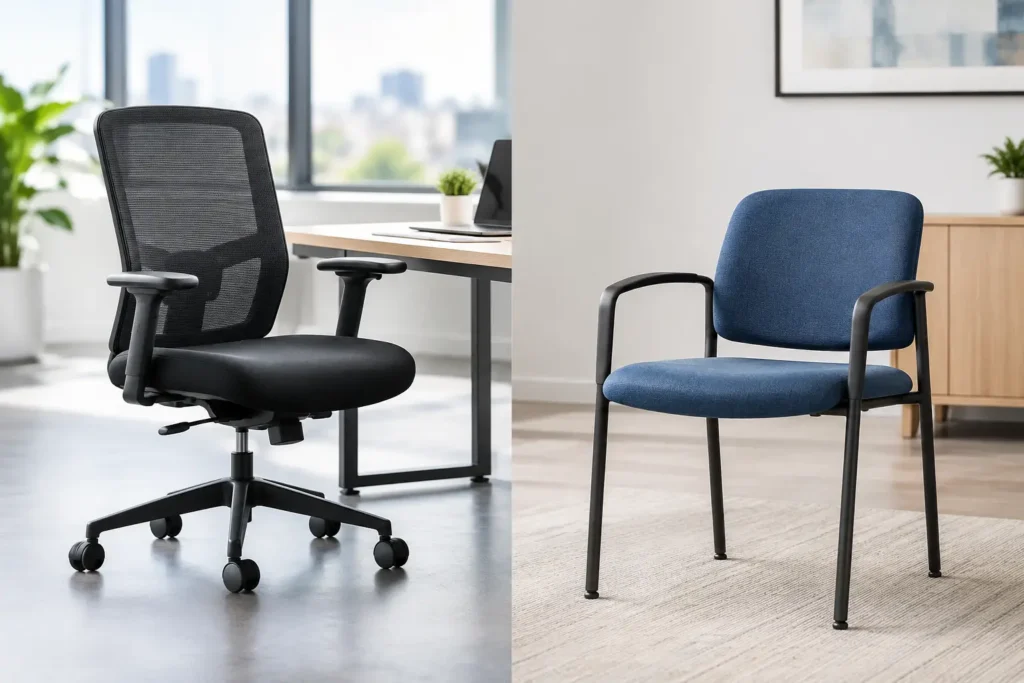
A workstation chair that looks polished in a private office can become a daily source of fatigue if it cannot adjust to the person using it. Likewise, a high-performance ergonomic chair is often the wrong allocation for a reception area where visitors sit briefly. The decision between task chairs versus guest chairs is therefore not simply a matter of appearance. It affects employee comfort, circulation, budget allocation, cleaning requirements, and the way a workplace serves different people throughout the day.
For commercial projects, the strongest seating plans assign each chair type to a defined use case. That approach creates a more functional office while keeping the visual language consistent across workstations, meeting rooms, executive offices, reception areas, and collaboration zones.
What Separates Task Chairs From Guest Chairs?
Task chairs are designed for active work at a desk or workstation. They typically include a five-star base with casters, a swivel mechanism, height adjustment, and ergonomic features that support changing postures through extended seated periods. Depending on the specification, they may also offer adjustable lumbar support, seat depth, arm height, recline tension, tilt lock, and headrests.
Guest chairs are intended for short-term or occasional seating. They are commonly used in reception areas, private offices, conference rooms, interview rooms, waiting areas, and guest-facing service environments. Many use fixed four-leg, cantilever, sled-base, or stacking frames rather than wheeled bases. Their construction prioritizes stable placement, ease of access, visual order, and durability under a changing mix of users.
Neither category is automatically better. A chair must match the duration, purpose, and setting of the sit. The mistake is treating all office seating as interchangeable because the finishes coordinate.
Task Chairs Versus Guest Chairs: The Operational Differences
Ergonomic adjustment and long-term comfort
A task chair serves an employee who may remain seated for six to eight hours, often while typing, reviewing drawings, participating in video calls, or moving between screens. Because users vary in height, weight, posture, and work style, adjustability is central to the specification. A seat that can be set to the proper height and depth helps users maintain more appropriate alignment with the desk and monitor. Adjustable armrests can also reduce strain during keyboard and mouse work.
Guest chairs do not need the same adjustment range when their typical use is a 15-minute check-in, a one-hour meeting, or a brief wait. Comfort still matters, particularly in conference rooms and executive offices, but it is achieved differently: supportive foam, a well-shaped back, appropriate seat width, and a stable frame can be more valuable than multiple controls.
There are exceptions. A training room used for day-long sessions may need guest-style chairs with stronger ergonomic support. Conversely, a touchdown station intended for brief laptop use may not warrant a fully adjustable task chair. The anticipated duration of use should guide the decision.
Mobility, circulation, and space planning
Casters and swivel bases allow task chair users to move easily between a keyboard, storage pedestal, printer, and adjacent work surface. That mobility supports individual productivity, but it also requires clearance. A task chair needs enough room to roll back, rotate, and be pushed into position without colliding with furniture or blocking an aisle.
Guest seating is often more predictable in plan. Fixed-base chairs hold their position, helping keep reception and meeting areas orderly. In compact executive offices, two guest chairs placed across from a desk can provide visitor seating without making the room feel crowded. In conference rooms, fixed or sled-base chairs may establish clean alignment along the table while simplifying circulation around the perimeter.
When planning either category, account for chair pull-back space, accessible pathways, door swings, and the location of power and storage. A seating schedule should work with the floor plan, not be selected separately from it.
Durability for different user patterns
Task chairs experience repetitive, concentrated use from the same employee. Their mechanisms, casters, arms, and upholstery should be selected for a high frequency of movement and adjustment. For offices with hard flooring, casters should be appropriate for the surface to protect both the floor and the chair’s performance. In shared work areas, durable textiles or cleanable performance materials can help manage a higher turnover of users.
Guest chairs are exposed to different stresses. Reception seating may be used by visitors carrying bags, wearing outerwear, or arriving from outdoors. Conference chairs may be moved repeatedly for room resets. Stackable seating needs frames and protective details that tolerate storage and handling. In public-facing environments, cleanability and stain resistance may matter as much as cushioning.
Commercial-grade construction is the baseline for both types. The relevant question is where the wear will occur: in moving parts and daily adjustments, or in surfaces, frames, and frequent repositioning.
Where Each Chair Type Works Best
Task chairs belong at assigned workstations, shared benching, private offices with regular desk work, control stations, and long-duration computer areas. They are also appropriate in meeting spaces where participants work on laptops for extended periods, such as project rooms, design studios, and training environments.
Guest chairs are well suited to reception desks, lobby seating groups, private-office visitor positions, interview rooms, consult areas, boardrooms, and conference rooms with shorter meeting cycles. They can also support flexible training rooms when specified with stacking capability and sufficient comfort for the intended session length.
A mixed approach is often the most effective. An executive office may include one ergonomic task chair behind the desk and two coordinated guest chairs in front. A conference suite may use task chairs in a technology-heavy war room and fixed guest chairs in a formal boardroom. The goal is not to standardize every seat, but to create a logical hierarchy of seating across the workplace.
Design Consistency Without Forcing One Chair Everywhere
Using different chair categories does not require a fragmented interior. Consistency can come from shared upholstery colors, complementary frame finishes, similar silhouette, or a coordinated material palette. A black task-chair base may pair naturally with black guest-chair legs, while matching upholstery connects seating across open offices, private rooms, and reception.
This is especially useful when an organization wants a cohesive brand presentation but has multiple functional zones. A highly adjustable task chair can look at home in a refined executive suite when it shares the same leather, textile, or metal finish language as the guest seating. Conversely, an overly residential guest chair may undermine the performance expectations of a commercial workplace, even if it photographs well.
Specify for maintenance as well as appearance. Consider whether replacement parts, upholstery cleaning, and future additions can be managed consistently. A coordinated furniture package is easier to maintain when finish standards and product specifications are documented from the start.
Budgeting the Right Way
Task chairs usually command a higher unit cost because they include mechanisms, adjustable components, and more complex construction. It can be tempting to reduce costs by using basic chairs at every desk, but that savings may be short-lived if seating fails to support employees doing sustained computer work.
At the same time, specifying premium ergonomic task chairs for every visitor seat can direct budget away from other high-impact requirements, such as work surfaces, storage, acoustic solutions, or reception furnishings. The better strategy is to invest where people spend time and where poor seating will create operational problems.
Build the budget around seat counts by function: assigned work seats, shared work seats, conference seats, private-office guest seats, reception seats, and training or multipurpose seats. This makes it easier to compare options without treating the entire project as one chair category.
Questions to Resolve Before Ordering
Before finalizing office seating, project teams should establish who uses each chair, how long they sit, whether the position is assigned or shared, and how frequently the room layout changes. They should also review workstation dimensions, flooring, cleaning protocols, weight capacity needs, and the desired level of adjustability.
For larger projects, mockups can prevent costly assumptions. Testing a proposed task chair with the actual desk height and monitor setup reveals more than viewing a product image. Placing proposed guest chairs around a conference table verifies knee clearance, arm clearance, and the number of seats the room can support comfortably.
FOH Furniture can support this process through coordinated furniture planning, commercial specifications, custom options, and project-focused sourcing. That level of coordination is particularly valuable when a project includes multiple chair types across several departments or locations.
The right seating plan gives employees the support to work well and gives visitors a clear, comfortable place in the workplace. Start with how each space is used, then select chairs that make that use easier every day.