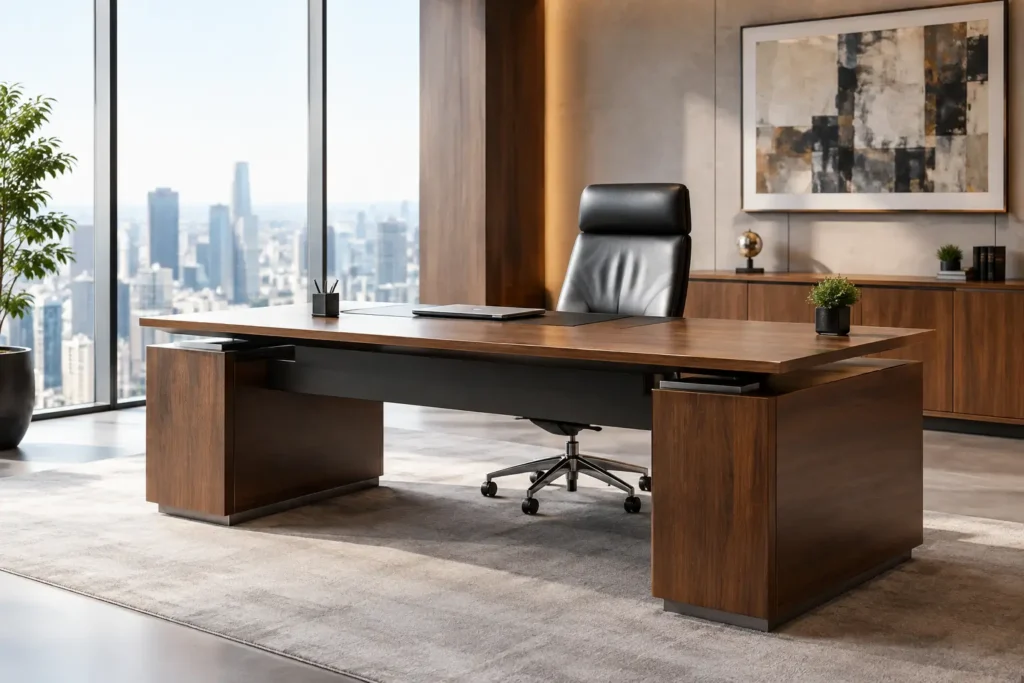
A leadership office is rarely used for one task. It may host confidential conversations, focused individual work, video calls, document review, and meetings with clients or team members in the same day. Executive desks need to support that range of activity while presenting a level of quality that aligns with the organization’s brand and workplace standards.
For commercial projects, the right desk is not simply the largest or most decorative option. It is a central piece of an office plan that must work with room dimensions, storage needs, technology, seating, circulation, and the broader furniture package. A well-specified desk helps leadership work efficiently and gives the room a deliberate, finished presence.
What Executive Desks Need to Accomplish
Executive desks carry greater functional and visual expectations than standard workstations. Their scale often establishes the hierarchy of a private office, but size alone does not make a desk appropriate for executive use. The desk should provide a practical work surface, accommodate the tools used by its occupant, and leave enough room for guests to sit comfortably without crowding the space.
In many offices, that means considering more than the primary desk top. A desk may be paired with a return, credenza, pedestal storage, bookcase, or small conference table. Together, these pieces create distinct areas for computer work, paperwork, secure storage, and face-to-face discussion. When they are selected independently, proportions and finishes can easily become inconsistent. When they are planned as a coordinated office package, the result is more functional and easier to install.
The visual role matters as well. An executive office may be one of the few spaces where customers, partners, candidates, or senior employees spend meaningful time. Wood-look finishes, laminate surfaces, metal details, modesty panels, and integrated storage all influence whether the room feels established, contemporary, approachable, or overly formal. The best choice depends on the company’s culture and the function of the office, not on a single universal style.
Start With the Room, Not the Desk
A common planning mistake is choosing the desk before confirming the office layout. A substantial executive desk can look appropriate in a product image yet overwhelm a smaller room once guest chairs, filing storage, and a door swing are accounted for. Conversely, an undersized desk can make a large private office feel sparse and can leave the user without the work surface or storage the role requires.
Begin by documenting the room’s usable dimensions, including windows, doors, wall outlets, HVAC locations, and built-in elements. Then identify the intended zones: a primary work area, visitor seating, storage, and, where needed, a meeting area. Clear circulation is essential. Staff and guests should be able to enter, sit, and move around the desk without squeezing between furniture or disrupting the person at work.
Desk orientation deserves careful attention. Placing the desk to face the door can support a traditional leadership-office layout, while positioning it perpendicular to windows may reduce glare on monitors. Sightlines also affect privacy. If the office is used for sensitive discussions, computer screens and paperwork should not be immediately visible from the doorway or guest seating.
Plan Around Work Habits
The executive who primarily works from a laptop has different needs than one who manages physical files, signs documents, reviews plans, or holds frequent one-on-one meetings. A clean rectangular desk may be sufficient for the first user. The second may benefit from an L-shaped configuration, a larger return surface, or a credenza that separates storage from active work.
It also depends on how leadership offices are used across the organization. Some workplaces have moved toward open, collaborative settings and use private offices mainly for focused work and confidential meetings. Others rely on enclosed executive offices as active operational hubs. The furniture specification should follow the actual work pattern rather than an assumed image of an executive office.
Specify for Commercial Use and Daily Wear
An executive desk is a long-term commercial investment. Its finish, substrate, edge treatment, hardware, and construction should be evaluated for regular use, cleaning, and relocation requirements. Offices with high visitor traffic or frequent meetings place different demands on furniture than lightly used private spaces.
Commercial-grade laminate remains a practical choice for many projects because it offers consistent finish options, straightforward maintenance, and reliable performance in active environments. Veneer or solid-wood elements can provide a more elevated appearance, particularly in client-facing executive suites, but they require a clear understanding of maintenance expectations and budget. Metal frames and bases can introduce a modern architectural profile while improving structural stability in larger configurations.
Storage components are equally important. Drawers should operate smoothly under regular use, locks should match privacy requirements, and file storage should be specified for the filing system in use. A desk with attractive cabinetry but insufficient document storage often leads to additional furniture being added later, which can disrupt the intended layout.
For multi-office projects, finish consistency is a procurement advantage. Specifying compatible desks, storage, conference tables, and guest seating helps maintain a cohesive appearance through phased build-outs and future replacements. It also gives facility teams a clear standard when offices change hands or expand.
Technology Planning Should Be Built In
Technology can quickly undermine an otherwise well-designed executive office. Loose cables, exposed power strips, and monitors placed wherever an outlet happens to be available create a cluttered, temporary appearance. They also make cleaning and future reconfiguration more difficult.
Determine early which devices the desk must support: desktop monitors, docking stations, charging equipment, desk phones, task lighting, or conferencing tools. Cable grommets, wire management channels, power access, and modesty panels should be selected as part of the desk specification. A return or credenza can often house equipment and reduce visual clutter on the main work surface.
Height-adjustable executive desk options may also be appropriate where organizations are prioritizing ergonomic flexibility. These solutions can support healthier work habits, though they need to be evaluated in relation to the office aesthetic, storage placement, and technology routing. A sit-stand desk is not automatically the right answer for every executive space, especially where a more traditional room profile or fixed millwork-style layout is required.
Create a Cohesive Executive Office Package
The desk should anchor the office, not stand apart from it. Guest chairs, ergonomic task seating, storage, occasional tables, conference seating, and lighting all contribute to how the room performs. A guest chair that looks appropriate but is uncomfortable during a 45-minute meeting is not a successful specification. Likewise, a premium desk paired with mismatched storage can weaken the credibility of the whole environment.
Color and material coordination should extend beyond the private office. Executive spaces often connect visually to reception areas, conference rooms, and open work areas. Repeating a wood tone, metal finish, upholstery color, or panel detail can create continuity without making every space look identical. This is particularly valuable for organizations that want a polished brand environment across several locations or departments.
FOH Furniture supports this process through coordinated commercial furniture planning, custom options, and project-focused sourcing. Instead of treating the desk as an isolated purchase, the goal is to align the entire office package with the project’s layout, use requirements, finish standards, delivery needs, and installation schedule.
Balance Customization With Project Control
Custom executive desks can solve real problems. They can fit an unusual room footprint, match existing architectural finishes, incorporate specialized storage, or provide dimensions that standard products cannot. For corporate headquarters, law offices, hospitality administration spaces, and other brand-sensitive environments, customization may be the most direct route to a finished, intentional result.
However, custom does not always mean better. Custom manufacturing can involve longer lead times, more approval decisions, and greater budget commitment. Standard or semi-custom commercial furniture may be the better fit when a project requires faster deployment, repeatability across multiple offices, or easier future replacement. The right level of customization is the one that resolves meaningful operational or design requirements without creating avoidable complexity.
A clear specification package helps keep decisions controlled. It should establish dimensions, finish selections, hardware, storage configuration, power requirements, delivery conditions, and installation responsibilities before ordering. This reduces the risk of receiving furniture that fits the design concept but not the room, elevator, doorway, or project schedule.
An executive office should give its occupant a practical place to lead, meet, decide, and focus. When the desk is planned as part of the complete commercial environment, it can do that work quietly and reliably for years.